By: MJ + PJ
The background on this post is this: While in Munich, our Sandeman’s tour guide had explained that children could not go on their tour of their nearby Dachau Concentration Camp, but that other companies and tours had different rules. They explained that if you found your own way to the site you might be able to take children in.
It is easy to understood why this is the case for tour companies. Is a concentration camp a place for kids to visit? They don’t want to repeatedly have that discussion, and their tours are obviously oriented to an adult audience. Like other historical sites, a concentration camp is certainly an eligible place from which learn deeply about a subject.
In terms of experiences on our adventure, our parenting position was to ensure AJ (actually – all of us!) had opportunities to observe the spectrums of both nature and humankind with our guidance. These spectrums have what we consider to be comfort and excitement axes: Angels Landing in Utah is high in excitement but low on comfort. Legoland is high on excitement and comfort. You get the idea. A concentration camp visit was going to be on the low end of both excitement and comfort.

For us, a WWII concentration camp was one of those things we had decided to see but were quite apprehensive about actually visiting. We were simultaneously interested and curious – feeling morally obligated in a way – but, to be honest, also kind of scared. It is a complex mix of motivations to make a visit to a concentration camp.
It is important to appreciate that it is not only adults who experience war. Children are present as bystanders in war, and subsequently experience incomprehensible vulnerability. We imagined that a visit to a concentration camp would clearly expose to us those children’s vulnerabilities, without having to directly experience it. This is observational learning. No family would choose to learn about this through direct experience.
We had met several traveling families on this adventure. While we may have only spoken for a short time with each, there was always mutual appreciation that travel is experience, not all experiences are equal, and there are some things that simply need to be seen. A traveling family we encountered in Porto had recently visited Auschwitz with their children (around AJ’s age), and they reported that visiting there had been a valuable experience for their family. This helped us, in that it reassured us.
Actually visiting a concentration camp means coming face to face with uncomfortable realities, regardless of how historical they may seem. As an adult you have a large experience bank to draw upon to guess how you will most likely react to novel situations. This works relatively well, until you put or find yourself in a situation for which you have no reference experience. Visiting a concentration camp is such a situation. How were we, as adults, going to react? It was not only AJ that we had to prepare, but also ourselves as adults. We were all going to exit our comfort zone.
As parents taking our child around the world, we talked about how to explain to AJ what he might see on this adventure, and how to answer his questions. Usually this was in preparation for something which was potentially dangerous, violent or scary. This is a parental protection instinct. While we wanted to answer his questions, we knew we did not have all the answers.
Something we had noticed when we answered his questions on these types of topics, was that we often over-explained. We gave him more information than he asked for, and we cast our adult justifications and assumptions over his (often simple) questions. This parenting realization came from seeing him tune out after the first sentence of our responses at times. He’d move on while we were formulating a too-complex answer! We found it better to answer honestly and simply, without reading too much into his questions. If he had more questions, keep being honest and keep it simple.
We are always sure to brief and debrief AJ on the more difficult places we visit. It really does not take much time (a few minutes usually), and it helps frame and later close the learning experience. There are always surprises, so it is always wise to have a rough second plan to enact if something turns sour. The best advice we can offer to reduce this risk is: remember that your children follow your lead – give the right cues for the situation, and be responsive to them and the experience.
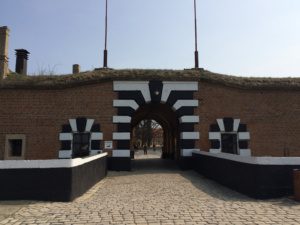
With all of this in mind, we found ourselves stepping off the tour bus at the Terazin Concentration Camp not far from Prague.
William J. Vondra
March 7, 2020 at 9:56amEnjoyed your details on the worldwide adventure…! Especially to the Czech Republic…. Wondering what details of PJ’s ancestry you were aware of.. I knew zip about your great grandfather’s mom’ family other than the maiden name V—-.. My interest rose as my dad’s cousins husband published a book on the V—- Family. in 2004, saw a copy in 2006 and found that there were 6 more siblings in my grand father’s family than the other three brothers that emigrated to the U S.with him…
That realization pushed me to google my grandma’s surname… ( random Came up with a Josef).. interesting read… was amazed as I read about the 1942 assassination of the Butcher of Prague.. and terrible reprisals against the Czech people…..possibly killed 10,000 people..
I thought that I sent a lengthy recap of family stuff last night along with a few pics, but I don’t see it posted here…. ( about an hour + of writing…) if you read it and have it fine…. I don’t want to re do it now… let me know if you don’t have it and are interested…